
Why Your Leadership Team Is the Variable That Matters Most
Strategy doesn't fail on the page. It fails at the table.
Every school leader you know is smart, mission-driven, and hard-working. That is not the variable. The variable is how the people at the top work together.
Seventy percent of organizational change efforts fail — and most trace back not to a flawed strategy, but to the team responsible for leading it. That number should stop every Head of School in their tracks. Because it means the most important leadership work you can do is not about vision or planning or communication. It is about what happens in the room where your senior team meets.
At Washington Partners, we use Patrick Lencioni's Five Dysfunctions of a Team as a framework for understanding what separates high-performing leadership teams from ones that struggle — and how to close the gap. We have adapted this model extensively for school environments, and it remains one of the most honest and useful lenses we have found for diagnosing the health of a senior leadership team.
Here is what the model teaches, and what it means for school leaders.
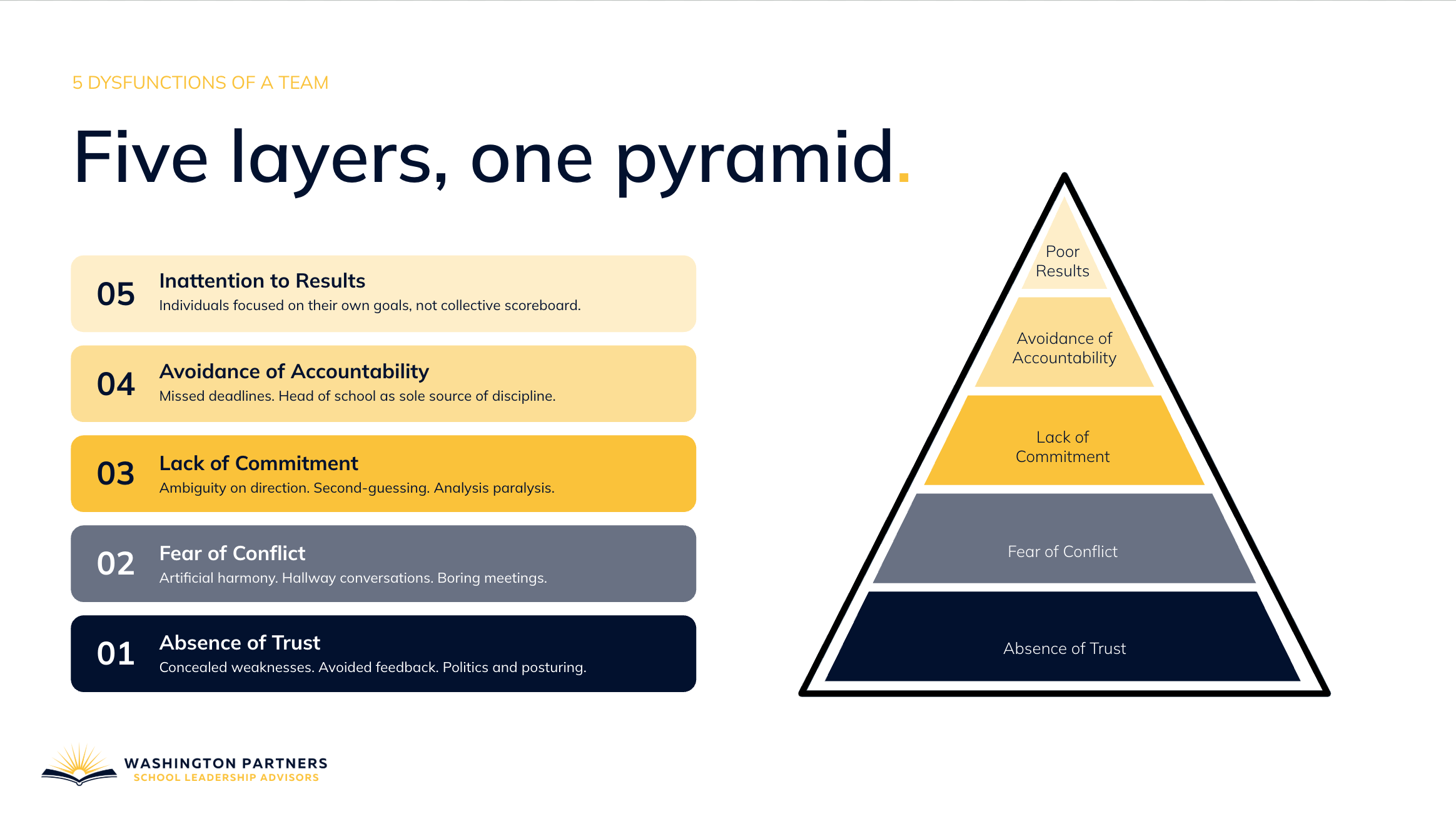
The Pyramid: Five Layers, Each Resting on the One Below
Lencioni's model is a pyramid — and like a real pyramid, everything above depends on the foundation beneath it. The five dysfunctions, from the base up, are:
Absence of Trust
Fear of Conflict
Lack of Commitment
Avoidance of Accountability
Inattention to Results
You cannot shortcut your way to the top. A team that avoids accountability will almost always trace the problem back to a lack of commitment. A team that cannot commit usually lacks productive conflict. And a team that avoids conflict is almost always protecting itself from vulnerability — which means the real issue is trust.
Start at the bottom.
Dysfunction One: Absence of Trust
The trust that matters on a leadership team is not predictive trust — the confidence that a colleague will do what they said they would. It is vulnerability-based trust: the willingness to say "I don't know," "I was wrong," or "I need help" in front of your peers, without fear that those admissions will be used against you.
In schools, the absence of this kind of trust is easy to spot, even if it is rarely named. Division heads who won't flag a struggling program until it has become a crisis. Senior leaders who posture in meetings to protect their turf and budget. After-meeting meetings in the parking lot where the real conversation finally happens. New hires who learn quickly — sometimes within their first week — to read the room before speaking honestly.
None of this is unusual. But all of it is costly.
The Head of School sets the conditions for trust more than anyone else. The single most effective thing a head can do to build trust is to go first — to model vulnerability publicly, to say "I made a mistake" or "I need your help" in front of the team, and to do so more than once.
Dysfunction Two: Fear of Conflict
Without trust, teams cannot debate. They settle, instead, for artificial harmony — which sounds fine until you realize that artificial harmony does not make the real disagreements disappear. It just moves them to the hallway.
Productive conflict is not about attacking people or winning arguments. It is passionate, unfiltered debate about ideas — pursued with the specific goal of reaching the best possible decision. High-performing teams mine for disagreement on purpose, because they understand that the discomfort of a real debate is a far better outcome than a decision that everyone privately doubts.
Most school leadership teams live at one of two extremes: avoidance or, occasionally, attacks that make disagreement personal. Productive conflict is the narrow middle — and getting there requires explicit permission from the head to disagree, along with active protection for those who do.
The cost of avoidance is high. Decisions get made in hallways. Politics fills the vacuum. Meetings become theatre. The same unresolved issue surfaces again six months later, slightly disguised.
The reward of doing it right is equally concrete: shorter meetings, better decisions, and team members who leave the room actually behind the outcome — not just tired of the conversation.
Dysfunction Three: Lack of Commitment
When real debate does not happen, people do not buy in to decisions. They tolerate them. And tolerated decisions never get executed with the urgency and alignment they require.
Commitment does not mean consensus. It means that everyone in the room was heard, the debate happened, a decision was made, and now every person at the table will support it publicly — including those who disagreed. The standard is not agreement. The standard is alignment after the decision.
Two things most reliably undermine commitment in school leadership teams: the desire for consensus (waiting until everyone agrees before deciding) and the need for certainty (waiting until there is no risk). Both are understandable instincts in environments as relationship-dense as schools. Neither produces good outcomes.
High-performing teams make informed decisions on imperfect information and move. They end every meeting with a cascading message: what did we decide, and what will we tell our teams?
Dysfunction Four: Avoidance of Accountability
Here is where school culture most often works against effective team leadership. Educators are trained in collegiality. The idea of calling a peer on performance or behavior that is hurting the team can feel transgressive — even unkind.
But avoidance of accountability in the name of politeness is not kindness. It is avoidance. And the consequences accumulate: poor performance tolerated for months or years, resentment building while nothing is said directly, and the Head of School becoming the sole source of feedback and discipline for an entire senior team.
The shift to aim for is from "the head holds people accountable" to "we hold each other accountable." When that shift happens, the head's job changes from enforcement to reinforcement — and the team begins to function as a genuinely self-governing group of professionals.
It is also worth naming what makes peer accountability possible: the three layers beneath it. Teams that trust each other, have worked through real conflict, and are genuinely committed to shared decisions find it far easier to hold one another accountable — because the accountability comes from care, not from policing.
Dysfunction Five: Inattention to Results
When the first four dysfunctions are present, people default to what they can control: their own division, their own status, their own career. The collective scoreboard gets ignored — or it never existed in the first place.
High-performing leadership teams focus collectively on a small number of shared outcomes, and they subordinate individual or departmental success to those outcomes when the two come into tension. In schools, that scoreboard might include enrollment, retention, faculty development, student outcomes, and mission fidelity — whatever the leadership team has collectively decided constitutes success for the year.
A useful diagnostic: can every person on your senior team name, right now, the three most important results your team is working toward this year? If the answers in the room would differ — start here.
What to Do About It
The model is useful precisely because it tells you where to start. Assess your team on all five layers, identify the lowest score, and begin at the bottom. Do not try to fix all five at once. This work needs time, consistency, and — above almost everything else — visible leadership from the head.
A few practices that move teams in the right direction:
On trust: Run a personal histories or working-styles exercise at your next leadership meeting. The head goes first. Models vulnerability. Receives feedback without defending.
On conflict: Name the undiscussables — out loud, in the room. Practice "mining for conflict" in real meetings. End each session by asking: what did we leave unsaid?
On commitment: Introduce a disagree-and-commit norm. Make it explicit. End every meeting with clarity on what was decided and what will be communicated to the broader school.
On accountability: Publish team goals. Public commitments are easier to peer-enforce. Create a regular progress review cadence — short, predictable, and consistent.
On results: Build a team scoreboard of three to five shared goals, visible at every leadership meeting. Celebrate team progress. Retire the individual-hero narrative.
The Closing Thought
Your school's future is not determined by the strategic plan. It is determined by whether the handful of people around your leadership table can trust each other, debate productively, commit to shared decisions, hold each other accountable, and keep their eyes on the shared scoreboard.
That is the work. And it is almost always more important — and more difficult — than whatever is on the agenda for next Tuesday's meeting.
Washington Partners works with school leadership teams to strengthen the conditions that make high performance possible. If this framework resonates — or if you recognize your team in some of these patterns — we would be glad to talk.
