
Why One Workshop a Year Isn't Enough: The Case for Leadership Communities in Schools
Most schools invest in leadership development the same way they invest in a good dinner out — it's meaningful in the moment, satisfying while it lasts, and largely forgotten by the following week.
An annual retreat. A conference in the fall. A speaker at the opening faculty meeting. The intentions behind these moments are genuine. But the results rarely match the investment. People return to the rhythms of school life, the pressures of daily leadership reassert themselves, and the insights from two days in a conference center quietly fade.
The problem is not the content. It is the container. Isolated events, no matter how well designed, cannot produce the kind of sustained leadership development that schools genuinely need — especially when those schools are in the middle of strategic change.
There is a better model. At Washington Partners, we call it Leadership Communities.
What Leadership Communities Are
A Leadership Community is a structured, year-long program that brings together a cross-functional group of school leaders — typically 15 to 25 people, spanning senior administrators, division heads, department directors, and other key institutional leaders — to develop their leadership capacity together over the course of an academic year.
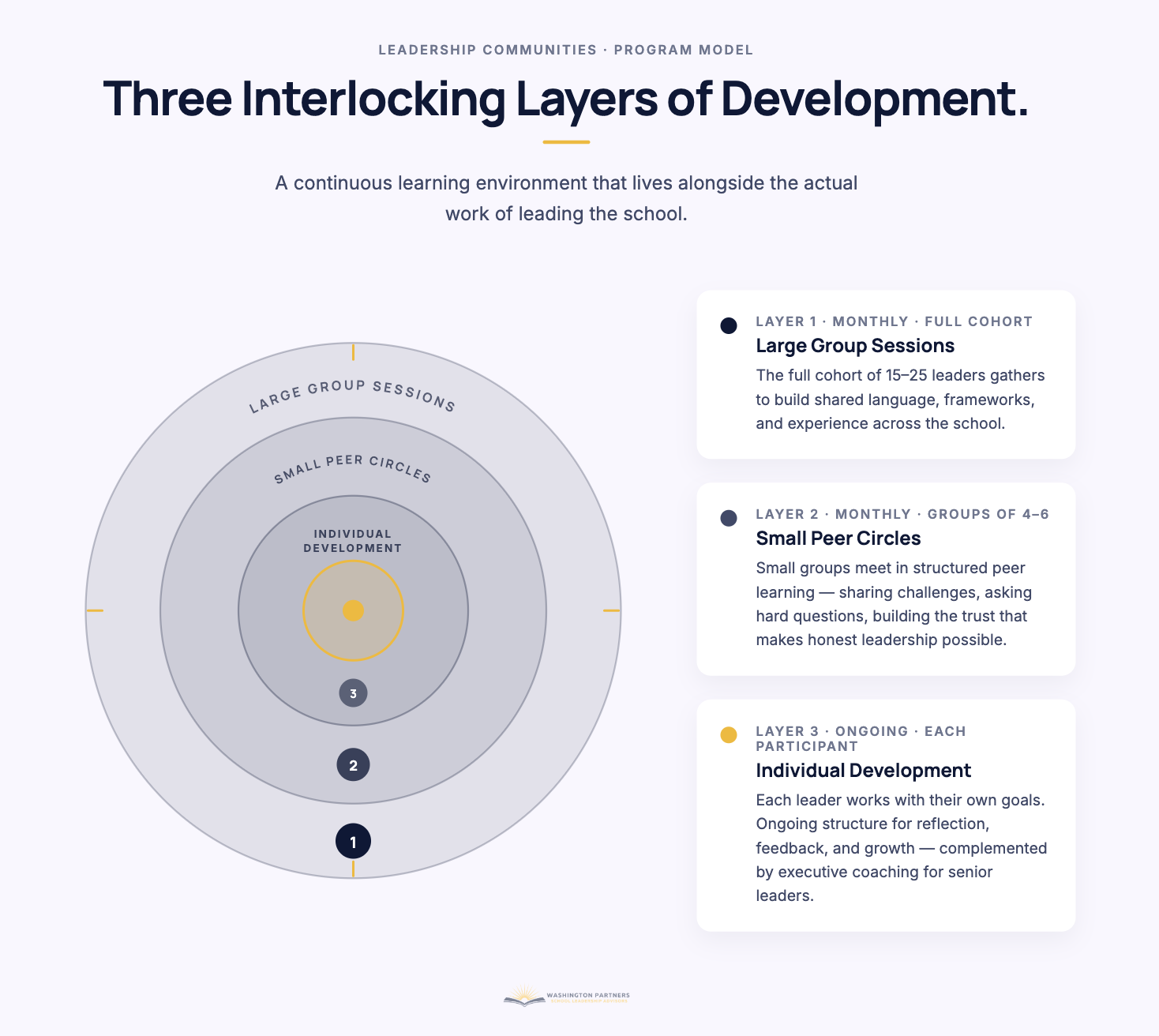
The model has three interlocking components:
Large-group learning sessions. Once a month, the full cohort gathers for a shared learning experience. These sessions are built around a carefully designed curriculum that progresses through the year — moving from foundational leadership topics in the fall to strategy, planning, and execution in the winter and spring. The large group creates shared language, shared frameworks, and shared experience across the school.
Small peer learning circles. Between large sessions, the cohort divides into small groups of four to six people. These circles meet monthly in structured, facilitated conversations — sharing challenges, applying what they are learning, asking each other hard questions, and building the kind of relational trust that makes honest leadership possible. The small circle is where the real work of development often happens.
Individual leadership development. Each participant enters the year with their own leadership development goals, and the program creates ongoing structure for reflection, feedback, and growth at the individual level. For senior leaders, this is often complemented by executive coaching.
Together, these three layers create something that a single retreat cannot: a continuous learning environment that lives alongside the actual work of leading the school.
Why the Model Works
The research is clear that leadership development sticks when it is experiential, relational, and sustained over time. Organizations with strong leadership bench strength are more than four times as likely to outperform their peers — but that bench strength is built through practice and repetition, not through one-time exposure.
Leadership Communities are designed around this reality. A few things make the model particularly effective in school environments:
It develops the whole leader, not just the skill. The curriculum arc moves from the inside out — beginning with personal leadership awareness and moving outward to team dynamics, organizational culture, and ultimately strategy. This sequence matters. Leaders who have not developed self-awareness and relational skill will struggle to lead strategic change, no matter how good the plan is.
It creates leadership language across the school. One of the most underappreciated benefits of a cohort-based model is what happens when a critical mass of leaders share the same frameworks, vocabulary, and experiences. Conversations that were once difficult become easier. Feedback that was once avoided becomes normal. The shared learning creates a common foundation that strengthens the entire institution.
It connects leadership development to real work. The curriculum is not abstract. It is designed to connect directly to the strategic challenges the school is actually facing — whether that is a new strategic plan, a cultural shift, a leadership transition, or an organizational restructuring. Leaders are not learning in a vacuum. They are developing capabilities they can apply immediately, in the context that matters most.
It builds capacity that stays. Many leadership development programs leave schools entirely dependent on outside consultants to sustain the work. Leadership Communities are designed differently. The model includes co-facilitation with leaders inside the school, who develop their own facilitation and leadership development capability throughout the year. By the end of the engagement, the practices and structures are embedded in the institution — not dependent on continued outside support to survive.
The Curriculum Arc
A well-designed Leadership Community unfolds in two distinct phases across the academic year.
Fall: Building the leadership foundation. The first half of the year focuses on the human conditions that make high-performing teams possible. Topics typically include trust and psychological safety, growth mindsets and adaptive thinking, feedback as a relational practice, and the listening and decision-making skills that enable real alignment. These are not soft topics. They are the foundation on which every strategic initiative depends. A team that cannot trust each other, give honest feedback, or make and keep commitments will struggle to execute any strategy, no matter how well-designed.
Winter and Spring: Strategy and execution. As the leadership foundation takes hold, the curriculum shifts toward strategy — how to think about it, how to build it, and how to execute it with the alignment and accountability needed to succeed. Leaders learn strategy frameworks and apply them directly to the challenges their school is working through. The transition from leadership development to strategic development is intentional: by the time a school is working on its strategic priorities, the leaders doing that work have spent months developing the relational and cognitive capabilities needed to do it well.
What Leadership Communities Are Not
It is worth being clear about what this model is not — because the contrast matters.
Leadership Communities are not a curriculum delivered to passive participants. They are experiential and dialogic, built around the belief that leaders develop most through reflection, conversation, and application — not through instruction alone.
They are not a senior team retreat. They intentionally span multiple levels and functions of the school, creating horizontal connections across the institution that would not otherwise exist. A division head and a director of facilities rarely have structured time to learn together. In a Leadership Community, they do — and that relationship becomes an institutional asset.
They are not a one-year fix. The year-long program is a beginning, not a destination. The most effective engagements are designed as part of a longer arc — where the first cohort of leaders develops the foundational practices, and that work then cascades outward through the organization as those leaders bring what they have learned into their own teams, departments, and direct reports.
Leadership Is a Culture, Not an Event
The school leaders who invest in Leadership Communities are not doing so because they are dissatisfied with their current leadership. They are doing so because they understand something important: in a school environment, where adults work closely together for many years and the stakes for students and families are high, the quality of leadership is not a background condition. It is the primary driver of everything else.
Strategy does not execute itself. Culture does not shift on its own. Trust does not develop from a two-day retreat. These things are built — carefully, consistently, over time — by leaders who have developed the capacity to lead with clarity, candor, and genuine care for the people around them.
That is what Leadership Communities are designed to produce. Not a better workshop. A different kind of school.
Washington Partners works with independent schools to design and facilitate Leadership Communities as part of a broader leadership development and strategic planning partnership. If this model resonates with where your school is right now, we would welcome the conversation.
